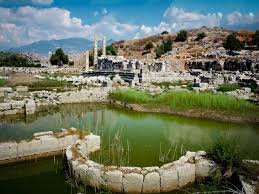
According to the poet Ovidius, the pregnant goddess Leto gave birth to her twin children, Artemis and Apollo, on the island of Delos. She then walked along the Xanthos River to the site where the Leto Temple stands today. In the legend, when she tried to bathe her children, the local people prevented her, and in her anger, she turned them into frogs. This myth forms the origin story of the Letoon Archaeological Site.
Excavations indicate that the first settlement at Letoon dates back to the 7th century BCE. The ruins and inscriptions reveal that Letoon was a political and religious center during the Lycian period. The ancient city features three temples side by side: the westernmost Ionic-style temple is dedicated to the goddess Leto, the smaller central temple to Artemis, and the eastern temple to Apollo.
The Apollon Mosaic, originally in the center of the temple, has been moved to the Fethiye Archaeology Museum to protect it from damage and is currently on display there. Inscriptions in Lycian, Aramaic, and Greek have been crucial for understanding the Lycian language. The site also includes a stoa and a Hellenistic theater, both of which are must-see attractions for visitors.

Renault Clio HB Benzinli Manuel

Fiat Egea Benzin Manuel

Citroen Elysee Dizel Manuel

Fiat Egea Dizel Manuel

Fiat Fiorino Dizel Manuel

Dacia Sandero Benzinli Otomatik

Citroen C3 Benzin Otomatik

Opel Corsa Benzin Otomatik

Renault Clio HB Benzin Otomatik

Dacia Duster Benzin Otomatik

Opel Crossland Benzin Otomatik

Opel Mokka Benzin Otomatik

Peugeot Yeni 2008 Benzinli Otomatik

Citroen C4 X Benzin Otomatik

Chery Tiggo 7 Benzin Otomatik

Peugeot 3008 Benzin Otomatik

Peugeot 3008 Dizel Otomatik

Citroen C5 Aircross Dizel Otomatik

Chery Tiggo 8 Benzin Otomatik

Peugeot 5008 Dizel Otomatik 7 Kişilik

Peugeot Expert Traveller Dizel Otomatik

Citroen Jumpy Dizel Otomatik

Peugeot Yeni 2008 Dizel Otomatik